PATRICK ROTHFUSS
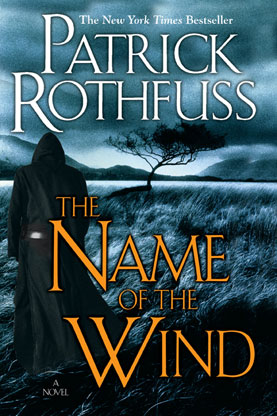 The first of these was Patrick Rothfuss, who is represented by Matt Bialer of Sanford J. Greenberger Associates. Rothfuss has published only two novels so far, both ranked as New York Times Best Sellers. (How one achieves this ranking is a subject for another column.) Rothfuss's books, The Name of the Wind (2007, DAW Books) and The Wise Man's Fear (2011, DAW Books) are the first two volumes in THE KINGKILLER CHRONICLES. They are definitely in the fantasy genre, which "commonly uses magic and other supernatural phenomena as a primary element of plot, theme, or setting, and since the publication of The Lord of the Rings, is dominated by its medievalist form." (Wikipedia entry on "Fantasy").
Readers who enjoyed Lord of the Rings and the Harry Potter series are in for a treat when they embark on The Kingkiller Chronicles. Rothfuss has created a fascinating world which, in a sense, picks up where Potter left off. Protagonist Kvothe finds his way to the University, where he studies to be an Arcanist. The words Rothfuss invents are tremendously creative; the cultures that he creates are sophisticated and sublime -- the Adem, a mercenary culture with whom Kvothe spends time in The Wise Man's Fear, for example, are like Samurai or Knights Templar, and yet wholly different: morally, they adhere to a strict warriors' code, the Lethani, but sexually they are uninhibited; though their faces remain impassive, they've developed a highly expressive sign language; and in their society, women are considered the superior fighters. In fact, all the female characters in The Kingkiller Chronicles are more fully developed than in most fantasy fiction, at least in my experience: from the elusive Denna, to the complex Devi, to the hermetic Auri, to the enchanting (literally) Felurian, to the harsh but exciting Vashet, there are many facets of the Feminine presented and explored with respect and creativity, though I'd be interested to hear a female viewpoint (The Geektress provides one on THIS blog entry).
One final word about this author and this series. I had never heard of DAW Books, the publisher of this series. What an amazing track record! And despite the fact that their website is "hosted" by Penguin Books, which presumably distributes their books, I was heartened by their statement that:
DAW is still a small private company, owned exclusively by its publishers, Elizabeth R. Wollheim and Sheila E. Gilbert. Betsy and Sheila are strongly committed to discovering and nurturing new talent, and to keeping a personal 'family' spirit at DAW—something they feel is all too rare in today's world of international conglomerate publishing."

The second of the authors I discovered during my agent search, Graham Joyce, is represented by Douglas Stewart at Sterling Lord.
Joyce is a Brit, and a multiple British fantasy novel winner. The thing is, his novels are less fantasy than magical realism, and he himself doesn't like the label "magical realism." He says (and I'm quoting his Wikipedia page here), "that his lineage is tied more closely to writers of the English “weird tale” such as Arthur Machen or Algernon Blackwood. He calls his style of writing “Old Peculiar.” I'm reading his book about midwives in the Midlands called The Limits of Enchantment (2005, Atria). It's SO good. Set in the Sixties. "Hedgerow Witches" are what people call the protagonist, Fern, and her wise woman adoptive mother, "Mammy."
A previous title, The Facts of Life (2003, Atria), is set post-WWII and again involves a "coven," of sorts: seven women who take turns raising a young boy, conceived under unusual circumstances. There's a bit of the "weird," and a great deal of superb characterization and intrigue.
I had not heard of Atria Books founded in 2002, either. It's no wonder. Though I worked in the New York publishing world a number of years ago, the upheaval and consolidation that seemed to be well under way back then has continued, unabated, into the present. The tricky thing about publishing has always been: how to support great writing, craft wonderful books, and still make some money. Atria Books seems to be doing okay: with the Dalai Lama and Lauren Weisberger (this links to Sidewinder L.A.'s cheeky discussion of ChickLit) on your list, how could you go wrong, right?


